What will the local church look like in 20 years? Take a peek into the youth room of your church and then visit the young adult class. The glimpse may be frightening. In many settings, children and youth ministries are failing to make disciples of Jesus Christ who stand in faith beyond their teenage years. Some church leaders are beginning to recognize the emerging result of ineffective family ministry.
Timothy Paul Jones identifies a two-fold problem: the identity of the parent and the responsibility of the church. Many church-going parents have delegated the “religious education” aspect to the youth or children’s ministry of the local church. Sunday School, youth group, children’s choir, VBS, and youth camp have become the primary “faith-building” activities for teens and kids. Yet, involvement in these programs does little to ensure children will grow into mature followers of Jesus.
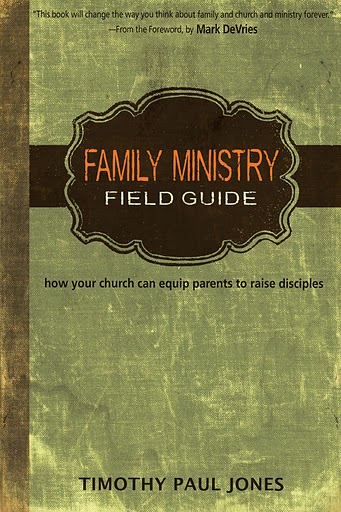
In his book, Family Ministry Field Guide, Dr. Jones offers a re-definition of family ministry: “the process of intentionally and persistently coordinating a ministry’s proclamation and practices so that parents are acknowledged, trained, and held accountable as primary disciple-makers in their children’s lives.” The concept is simple. Equipping parents to lead their children spiritually is the responsibility of the church. Equipping children to trust Jesus for salvation, grow in the grace of God, and worship/serve the Lord faithfully is the responsibility of the parents. When local fellowships discontinue a surrogate philosophy and embrace an empowerment mentality, trends of young adult disengagement from faith will decrease.
Dr. Jones offers practical applications for church fellowships to consider. He recognizes that “…merely getting families to engage in devotions or discipleship practices isn’t even the right goal… The goal of family ministry is for parents to see themselves in the light of the gospel.” He offers a multitude of examples for church leaders to consider, including formal and informal disciple-making activities. Yet, the goal is not to create busyness of activity but a “deepening of Gospel identity.” Church leaders may find themselves “doing less so that parents have time to do more.”
Dr. Jones is not suggesting that local churches completely scrap children and youth ministry. He is not a proponent of the “family-integrated model” that eliminates the nursery, children’s programming, and youth activities. He is, however, calling the church to a renewed biblical view. “In family-equipping ministry, age-focused ministers and volunteers remain in place, but they find themselves playing very different roles than ever before.”
Within the “family-equipping model” proposed by Dr. Jones, parents are admonished to embrace a training mentality. “Parents are the primary teachers in their children’s lives, even if they don’t know it.” He is correct. Parents cannot expect that their children will develop spiritual habits and values beyond that which is modeled in the home. Parents are called by God to not only be good examples, but to actively pursue the training of their children. “Fathers, do not provoke your children to anger, but bring them up in the discipline and instruction of the Lord.” (Ephesians 6:4, ESV) Dr. Jones asks a diagnostic (and scary) question. If our children were independently asked, he wonders, “Would they identify their parents as the primary people who are teaching them the truths of God?”
Dr. Jones concludes that the ministry to families is critical to the entire health of the church. “Church leaders who effectively equip families understand that one essential component in preparing God’s people for works of ministry (Ephesians 4:12) is training parents to teach their children.” It is the ministry of church leaders to provide edifying tools that teach and train parents to equip and nurture the faith of their children.
In the development of a Family Discipleship Plan over a year ago, a friend provided a copy of this book for my consideration. I am grateful that Brian Upshaw not only provided this resource but also consulted with me on a number of occasions since then regarding discipleship and the equipping of our families. I highly recommend that every pastor, church staff member, and church leader who connects with families read this book.
 Shepherding Well