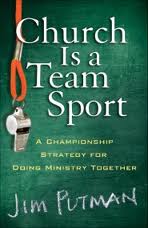
What does the sport of wrestling have to do with church? Pastor Jim Putman would give the answer of “everything” in his book, Church is a Team Sport, because people understand sports better than they do church. Putman was a three time All-American collegiate wrestler who came to Christ after college. For ten years, he served as a high school coach and as a youth pastor. From this position, God called him to develop and lead Real Life Ministries. He discovered how to be a “coach” who leads a church to win.
Jim Putman believes that church leaders have one role: to shepherd people. He has translated his sports experience to the church in a very effective and applicable way. Everything in this book revolves around the concept of team. Putman explains this theory by stating, “… I believe that the church is supposed to be a collection of transformed individuals molded by God into a team. The Christian life is a team sport.”
Putman defines the word church as “a body of believers working as individuals and together as a team to achieve the Lord’s goals. Our winning team reaches the world with the message of the gospel then disciples those who have been won to obedience and replication.” The premise of this book is neither original nor innovative, yet it surfaces as one of the best on the subject.
Based on his assumption that a winning church makes disciples, Putman makes the evaluation that most churches are losing. He defines a disciple as a convert who becomes a part of God’s team and is taught to take part in God’s mission. Disciples stand up to the pressures of the world, share their faith without shame, display the fruit of the Spirit, and have healthy and growing relationships with others and with God. Putman declares, “Churches often have stated goals but [they have] behaviors that circumvent or work against them.”
While these goals of disciple-making are shared by all Christian leaders who seek to honor Christ, Putman has a ridiculously simple means by which he fulfills them. He earnestly seeks to connect with every member and looks for ways to empower them to lead in ministry. His weekly routine has not changed from the beginning with 142 people to the over 10,000 members today. Every week, Putman, with the help of his staff, calls each family who missed the Sunday service. “We believe people are not numbers but are family who appreciate their absence being noticed.” This is the essence of caring for his people.
Pastor Jim Putman believes that discipleship is relational. He explains the philosophy that was adopted even before their first church service, “When someone came to the Lord, they needed someone to walk with them; they needed to be taught. When someone was sick, we needed to be there to pray and to help.”
Most churches measure winning by the attendance or offering. Putman has a different perspective as he states, “Numbers don’t mean much unless you are counting the number of people being transformed by the Holy Spirit.” As Real Life has focused on discipleship, God has exponentially increased their numbers.
Putman gives an accurate reading of the scoreboard for most churches in America and these teams are losing. He analyzes that churches have fallen behind in the game because they have forgotten the mission, conform more the world, fail to share the faith, and are biblically illiterate. The problem is that churches have focused on everything but biblical discipleship. In giving the solution, Putman proclaims, “…the answer to the problem starts with the leadership…those that are called to be pastors and leaders- the coaches for God’s team.”
Putman gives a great analogy that identifies a major problem in church leadership. “…Somehow pastors have come to believe that they are paid players, and the people who attend are the fans.” The senior pastor then becomes the star player and he begins to think that gaining a bigger crowd is dependent on his preaching performance. This mentality filters down into every aspect of the church. “Most of the money given by the fans is used for the development of a better show, not for helping people or building new players.” Putman gives the reality that if a church gains people because it has the best show in town, then people will leave when they hear of a better one.
Putman believes that people will stay in church because they know they are loved; they are part of the team. He has a unique way of viewing the preaching ministry of the church. He believes that a sermon will only connect with people when the pastor is constantly investing his time building relationships with them. When a pastor abandons the “big show” mentality that focuses on himself, then he is free to “find and develop players who will later become coaches themselves.” A winning church is one that is working to fulfill the Great Commission.
This book is a “must read” for all church leaders and a recommended reading for all followers of Christ. Jim Putman offers the best overview of a disciple-making church and a practical guide to help leaders implement this philosophy into a current ministry setting. The book is easy to read as it has a logical flow from stating the problem to offering biblically based solutions, with the author illustrating his points by sharing his own stories of failure and success. If creating a culture of teamwork in the mission of Christ is winning, then Pastor Jim Putnam has given the body of Christ a great tool in Church is a Team Sport.
Get your copy here: http://www.christianbook.com/church-championship-strategy-doing-ministry-together/jim-putman/9780801072086/pd/072086?item_code=WW&netp_id=585667&event=ESRCN&view=details
What do you think? Is the church today “winning?” Leave me a comment below.
 Shepherding Well
Is the church today winning? I have to say yes and no. It is not a cop out answer. The church today are holding on, they have not been eliminated yet, or thrown the towel in, or hit the mat. A look at History reveals that the church has basically always had three groups; 1) team players who are playing the game, 2) teams players whose hearts are in the game and giving all they have to win. And of course you have 3) team players that just want to ride the bench for whatever reason.
I wish the church were doing better, but I understand that it is all a process for players to need coaches, to need cheerleaders and to need each other. As a church we all have a part to play while it is still day or while we are up to bat, so get in there and do your best.